

Rise Over Run: The First Movement Pattern
Before a gymnast learns to flip, they learn to travel. Rise over run — the slope — is the first movement pattern in gymnastics, and one of the most important lessons in life.
Listen to this post
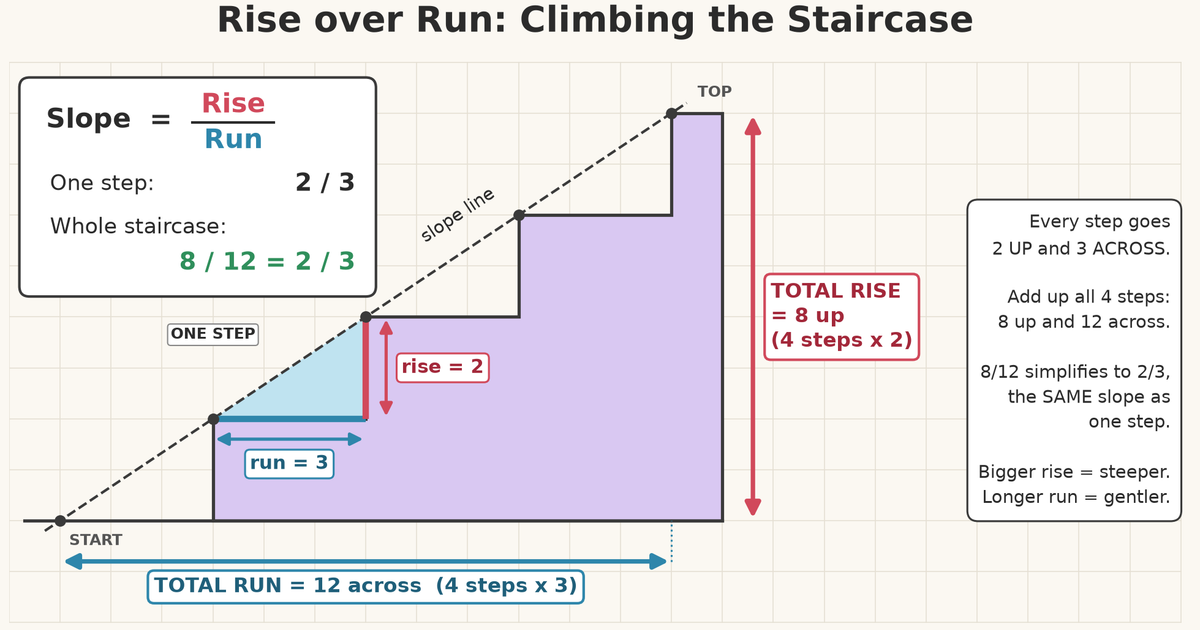
You probably learned it in a middle school math class. The teacher wrote it on the board, you copied it into your notebook, and you moved on. Rise over run. The slope of a line. A formula for how much something goes up relative to how far it travels forward.
What nobody told you is that your body already knew it.
Long before algebra class, every child who has ever run across a room and launched themselves into a cartwheel has already solved for slope. They felt it in their legs, their hips, their arms. They adjusted it instinctively — leaning forward when they needed more power, pulling back when they needed more height. They were doing math. They just did not have the words for it yet.
At Twisters, we give them the words. And we start with rise over run.
What Slope Has to Do With Gymnastics
In algebra, slope describes the relationship between vertical change and horizontal change along a line. A steep slope means a lot of rise for a little run. A shallow slope means a lot of run for very little rise.
In gymnastics, slope describes the relationship between a gymnast's body angle and their direction of travel. And it shows up everywhere — in the approach to a round-off, in the angle of a hurdle, in the lean of a cartwheel, in the trajectory of a back handspring.
Every time a gymnast moves across the floor, they are managing slope. They are deciding — consciously or not — how much rise to put into each unit of run. Get it right, and the skill flows. Get it wrong, and the skill stalls, falls short, or goes sideways.
The slope is not a detail. It is the architecture of movement.
The Approach: Where Slope Begins
The first place we teach rise over run explicitly is in the approach — the run-up that precedes almost every tumbling skill.
Most beginners think the approach is just about speed. Run fast, hit the skill. But speed without direction is just chaos. What the approach is really about is building a specific slope — a body angle that will convert horizontal momentum into vertical power at exactly the right moment.
Think about a ski jumper. They do not run straight at the ramp and hope for the best. They build their approach at a precise angle, lean into the slope, and let the ramp redirect their momentum upward. The jump is not created at the ramp. It is created in the approach.
Gymnastics works the same way. The height of a back handspring, the rotation of a round-off, the power of a front aerial — all of it is shaped by the slope of the approach that precedes it.
When we teach young gymnasts to feel their approach, we are teaching them to manage slope. We are teaching them that where you are going is shaped by the angle at which you arrive.
Rise: The Vertical Dimension
Rise is the upward component of movement — the lift, the height, the vertical ambition of a skill.
In gymnastics, rise comes from the hips. When a gymnast drives their hips upward through a skill — in a hurdle, a jump, a punch rebound — they are generating rise. The more efficiently they generate rise, the higher they go, the more time they have in the air, and the more rotation they can achieve.
But here is the thing about rise: you cannot manufacture it at the top. You have to build it from the bottom. Rise is the result of everything that happened before the moment of takeoff — the approach angle, the foot placement, the hip drive, the arm swing. By the time a gymnast leaves the ground, the rise is already determined.
This is one of the most important lessons we teach, and it applies far beyond the gym: you cannot create lift at the moment of launch. You build it in the approach.
Run: The Horizontal Dimension
Run is the forward component of movement — the travel, the momentum, the horizontal engine that powers everything else.
In gymnastics, run comes from the legs and the lean. A gymnast who runs with their weight back is fighting their own momentum. A gymnast who runs with their weight forward — leaning into the direction of travel, letting gravity assist — is building run efficiently.
But run without rise is just running. It does not become a gymnastics skill until the gymnast converts that horizontal momentum into something vertical. That conversion — that moment when run becomes rise — is the pivot point of every tumbling pass.
The ratio of rise to run at that pivot point is the slope. And the slope determines everything.
Why We Teach This to Young Gymnasts
You might be wondering: do we actually use the words "rise over run" with a six-year-old?
Sometimes, yes. Kids are smarter than we give them credit for, and they love knowing the real name for something. But more often, we teach the concept through the body before we give it a name.
We use incline mats — wedges that physically build slope into the environment — so gymnasts can feel what a helpful angle does to their movement. We use visual cues: "lean like you're walking into the wind," "reach your chest toward the far wall," "let your hips lead." We use games that reward the right approach angle without ever mentioning algebra.
By the time a gymnast is old enough to encounter slope in a math class, they already know it in their bones. The formula is just a way of naming something they have been living.
The Life Lesson Inside the Movement Pattern
Here is where it gets interesting.
Rise over run is not just a gymnastics concept. It is a framework for understanding how effort and direction combine to create outcomes — in any domain.
Think about a goal you are working toward. The rise is the outcome you want — the height you are trying to reach. The run is the time, effort, and forward movement you are putting in. The slope is the relationship between them: how much progress you are making per unit of effort.
A slope that is too steep — all rise, no run — looks like impatience. You want the result immediately, without the approach. You try to generate lift at the moment of launch, and there is nothing there.
A slope that is too shallow — all run, no rise — looks like busyness without progress. You are moving, but you are not going anywhere. Lots of effort, not much lift.
The right slope is the one that converts your forward movement into upward progress at the right moment. And finding that slope — for a skill, for a goal, for a season of training — is one of the most important things a gymnast learns to do.
Adjusting the Slope
One of the things we love most about teaching rise over run is that it gives gymnasts a language for self-correction.
When a skill is not working, the question is not just "what went wrong?" The question is "what was the slope?" Was there too much rise and not enough run — did the gymnast go up before they had enough momentum? Or too much run and not enough rise — did they travel forward when they needed to go up?
Once a gymnast can diagnose their own slope, they can fix it. They are not waiting for the coach to tell them what happened. They are reading their own movement, adjusting their own angle, and solving for the right ratio on the next attempt.
That is a skill that transfers. A student who can look at a failed attempt — in the gym, in school, in a relationship — and ask "what was my slope?" is a student who can learn from failure without being defeated by it.
The First Pattern Is the Deepest One
We call rise over run the first movement pattern not because it is the first thing we teach in a literal sense, but because it is the pattern that underlies everything else.
Every skill in gymnastics has a slope. Every approach, every takeoff, every flight path, every landing — all of it can be described in terms of rise and run. When a gymnast understands slope, they have a lens through which every skill becomes more readable, more learnable, more correctable.
And when a person understands slope — really understands it, in their body and not just on paper — they have a lens through which effort and direction and outcome start to make sense together.
That is what we are teaching when we teach gymnastics. Not just skills. Patterns. And the first pattern is rise over run.
At Twisters Gymnastics, we believe every movement has something to teach. If you want your child to learn the patterns that build both great gymnastics and great thinking, come see what we are building on the floor.
Want your child to learn movement the right way from day one? Enroll at Twisters Gymnastics — Santa Clara's gymnastics home since 1986.
Explore Topics
Written by
Allan Fusilero, Owner of Twisters Gymnastics — with research assistance from Grok, Perplexity, and ChatGPT
Content creator and writer sharing insights and stories.


