
The Landing: How You Finish Is How You Are
Every gymnastics skill ends the same way — with a landing. How a gymnast absorbs that moment reveals everything about their training, and everything about their character.
Listen to this post

Watch a gymnastics competition and you will notice something. The crowd does not react when the gymnast takes off. They do not react in the middle of the skill. They react at the landing.
A stuck landing — feet together, arms up, body still — draws a gasp and then a cheer. A stumble, a step, a sit-down draws a different sound entirely. The landing is the moment everyone is waiting for, because the landing is where the skill is judged.
But here is what most people watching do not realize: the landing was decided long before the gymnast's feet hit the floor. It was decided at takeoff. It was decided in the air. It was decided in every practice rep that came before this one.
The landing is not the end of the skill. It is the proof of everything that came before it.
What the Landing Actually Is
In biomechanical terms, a landing is a deceleration event. The gymnast has been moving — fast, rotating, flying — and now the body must absorb that momentum and bring it to zero. The forces involved are significant. A gymnast landing from a tumbling pass can experience ground reaction forces three to five times their body weight in a fraction of a second.
The body has a system for handling this. It is called the triple flexion response — the simultaneous bending of the ankles, knees, and hips that distributes the impact load across multiple joints and the large muscle groups surrounding them. Done correctly, it is elegant and nearly silent. Done incorrectly — with locked knees, a stiff back, or a forward lean — the force has nowhere to go except into the joints themselves.
This is why we teach landing mechanics from the very first class. Not because we are worried about competition scores. Because we are worried about knees.
The Stuck Landing: What It Requires
A stuck landing — the kind that earns a full score, the kind that makes the crowd go quiet for a moment before they cheer — requires three things to happen simultaneously.
Absorption. The ankles, knees, and hips bend together to receive the force. Not one before the other. Together. The timing has to be precise, because a joint that locks while the others are still moving becomes the point where all the force concentrates.
Stability. The core must be braced at the moment of contact. A soft core at landing means the torso collapses forward or sideways, and the gymnast steps to catch themselves. A braced core means the upper body stays over the base, and the gymnast stays still.
Completion. The arms come up. The head lifts. The chest opens. This is not decoration — it is the final counterbalance that keeps the body from pitching forward. A gymnast who lands with their arms down and their eyes on the floor is already falling. A gymnast who lands with their arms overhead and their eyes forward is finished.
All three have to happen at once. That is what makes the stuck landing hard. And that is what makes it worth practicing.
Why We Practice Landings Separately
One of the things that surprises parents when they watch our classes is how much time we spend on landings in isolation — jumping from a low height and sticking, stepping off a beam and absorbing, dropping from a bar and landing clean — before any of those landings are attached to a skill.
The reason is simple: under pressure, the body does what it has practiced most. If a gymnast has only ever practiced landings at the end of a skill — when they are tired, when they are thinking about the rotation, when the hard part feels like it is already over — then the landing is always an afterthought. The body treats it like one.
If a gymnast has practiced the landing hundreds of times as its own skill — as something that requires full attention and full effort — then the body knows what to do when it arrives. The absorption is automatic. The stability is there. The arms come up.
We are not just training the landing. We are training the gymnast to finish.
The Step: What It Tells You
Every gymnastics judge knows that a step on the landing is a deduction. But what a step actually tells you is more interesting than the score it costs.
A step is the body's way of finding the balance it did not have at the moment of contact. The gymnast's center of mass was not over their base of support, so the foot moved to get under it. The step is not a failure of effort — it is a success of the body's emergency system. The gymnast did not fall. They found a way to stay upright.
But the step also tells you something about what happened earlier in the skill. A step forward usually means the gymnast was leaning forward in the air — chest down, hips behind, the body already tipping toward the floor before the feet arrived. A step backward means the opposite. A step to the side means the rotation was not square, that the body arrived twisted.
When we see a step, we do not just correct the landing. We go back to the source. Where did the body lose its line? Was it at takeoff? In the air? At the peak? The landing is the evidence. The fix is upstream.
The Life Lesson in the Landing
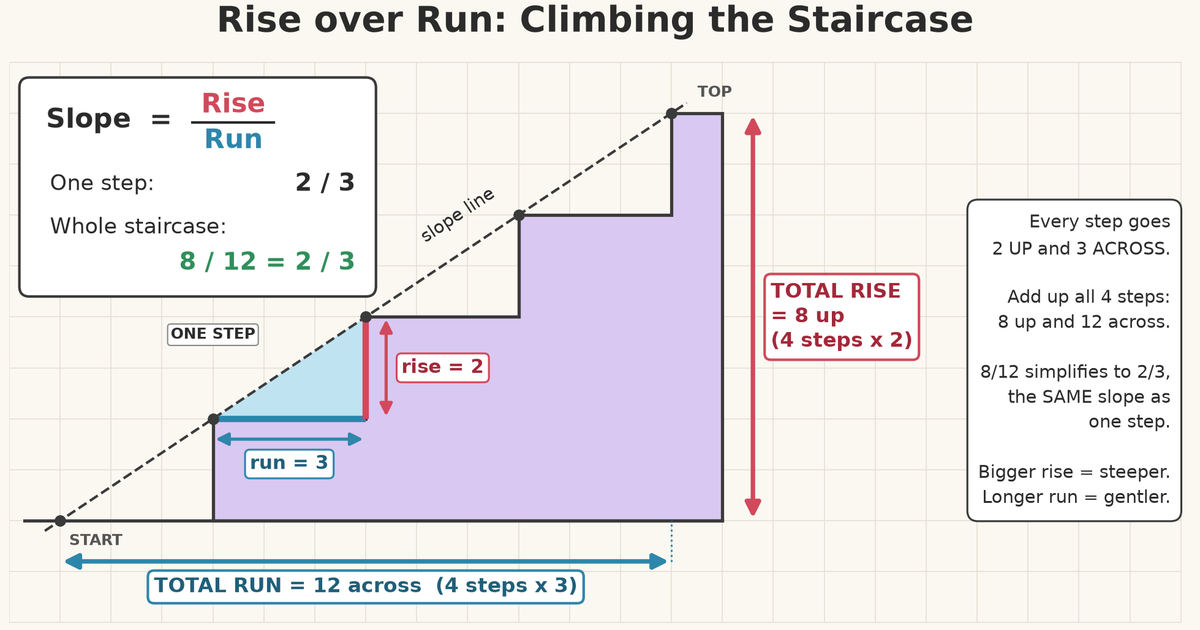
This series has been building toward something. We started with The Mark — the zero point, the body's home position, the foundation that everything else is built on. We moved to Rise Over Run — the approach, the slope, the way you build toward something. We talked about Stiffness at the Vertical — holding your shape at the peak, not collapsing when the pressure is greatest.
The landing is where all of it comes together. And the lesson it carries is the one that might matter most.
How you finish things is how you are.
Not how you start them. Not how you look in the middle. How you finish.
A gymnast who trains hard for months and then stops caring in the last two seconds of a skill — who lets the arms drop, who stops bracing, who treats the landing as an afterthought because the hard part is over — is practicing something. They are practicing the habit of not finishing. And that habit does not stay in the gym.
The student who stops paying attention in the last five minutes of class. The employee who rushes the final details of a project because the deadline is close. The person who stops showing up for the people they care about once the exciting part of the relationship is over. These are all versions of the same thing: treating the landing like it does not count.
It counts. In gymnastics, it counts for a significant portion of the score. In life, it often counts for everything.
Teaching the Finish
At Twisters, we end every skill with the same cue: "Finish it."
Not "stick it." Not "don't step." Finish it. Because finishing is an active thing — it requires intention, attention, and effort all the way to the last moment. It is not something that happens to you. It is something you do.
We say it so often that our gymnasts start saying it to each other. They say it when a teammate is about to land. They say it to themselves before they go. It becomes a standard — not just for gymnastics, but for how they approach anything that matters.
Finish it.
Arms up. Eyes forward. Still.
That is the landing. That is the skill. That is the whole point.
The Arc, Complete
This series started with a question: what does gymnastics actually teach?
Not the flips. Not the medals. Not the flexibility or the strength, though those matter too.
What gymnastics teaches — what it is uniquely positioned to teach — is the full arc of a purposeful action. You find your foundation. You build your approach. You hold your shape at the peak. And you finish.
The Mark. Rise Over Run. Stiffness at the Vertical. The Landing.
Four posts. Four skills. One lesson.
How you do anything is how you do everything. And the gym is one of the few places left where that lesson is taught with your whole body, every single day.
At Twisters Gymnastics, we believe the skills gymnasts learn on the floor follow them everywhere. Every class is a chance to practice not just gymnastics — but the habits of a person who finishes what they start.
Explore Topics
Written by
Allan Fusilero, Owner of Twisters Gymnastics — with research assistance from Grok, Perplexity, and ChatGPT
Content creator and writer sharing insights and stories.